Most of what gets called teething is just a baby having a hard week while a tooth happens to be coming. The useful question is not "is this teething" but "is this on the short list".
What is teething, and how often it shows up
| Sign | Is it teething? | How often it is reported |
|---|---|---|
| Sore, irritated gums | Yes | 87%, the most reported of all |
| Increased biting and chewing | Yes | 66% |
| Irritability | Yes | 61 to 68% |
| Drooling | Yes | 56% |
| Broken sleep, going off food | Yes | On every published list, not separately counted |
| A fever of 38C (100.4F) or above | No | Not explained by teething |
| Diarrhea | No | Teething does not reach the gut |
| A cold, runny nose or cough | No | Teething does not touch the immune system |
| Crying that will not settle | No | Teething discomfort is not usually that severe |
| Diaper rash | No | Teething does not change skin below the waist |
The short version.
- Sore gums are the one sign nearly every teething baby has
- Dribbling, chewing and a short fuse are the rest of the real list
- A real fever, diarrhea or a bad cold is a coincidence of timing, not a symptom
- Most teething discomfort is mild and short, so severe is a signal, not a stage
- Symptoms can show up with no tooth visible for weeks
- If you would be worried without the teething, be worried with it
What the published lists agree on, and where they stop
Three bodies publish a teething symptom list, and they are close enough that the overlap is the useful part.
The shared core is sore or swollen gums, more dribbling than usual, chewing and gnawing on everything, a more fretful baby than normal, and broken sleep. Cleveland Clinic adds loss of appetite. The NHS adds two specific details worth keeping: one flushed cheek, and a rash on the face.
Note the precision on that first one. The list says one cheek, not a pair. Two red cheeks is outside what the guidance describes, which does not make it serious, but does make it worth a second look rather than an assumption.
The rash is a dribble rash, caused by saliva sitting on skin rather than by the tooth, which is why it turns up where drool lands and nowhere else.
How often each sign actually appears
This is the part most symptom lists leave out, and it changes how you read them. A list of nine signs implies nine equally likely things. The research says otherwise.
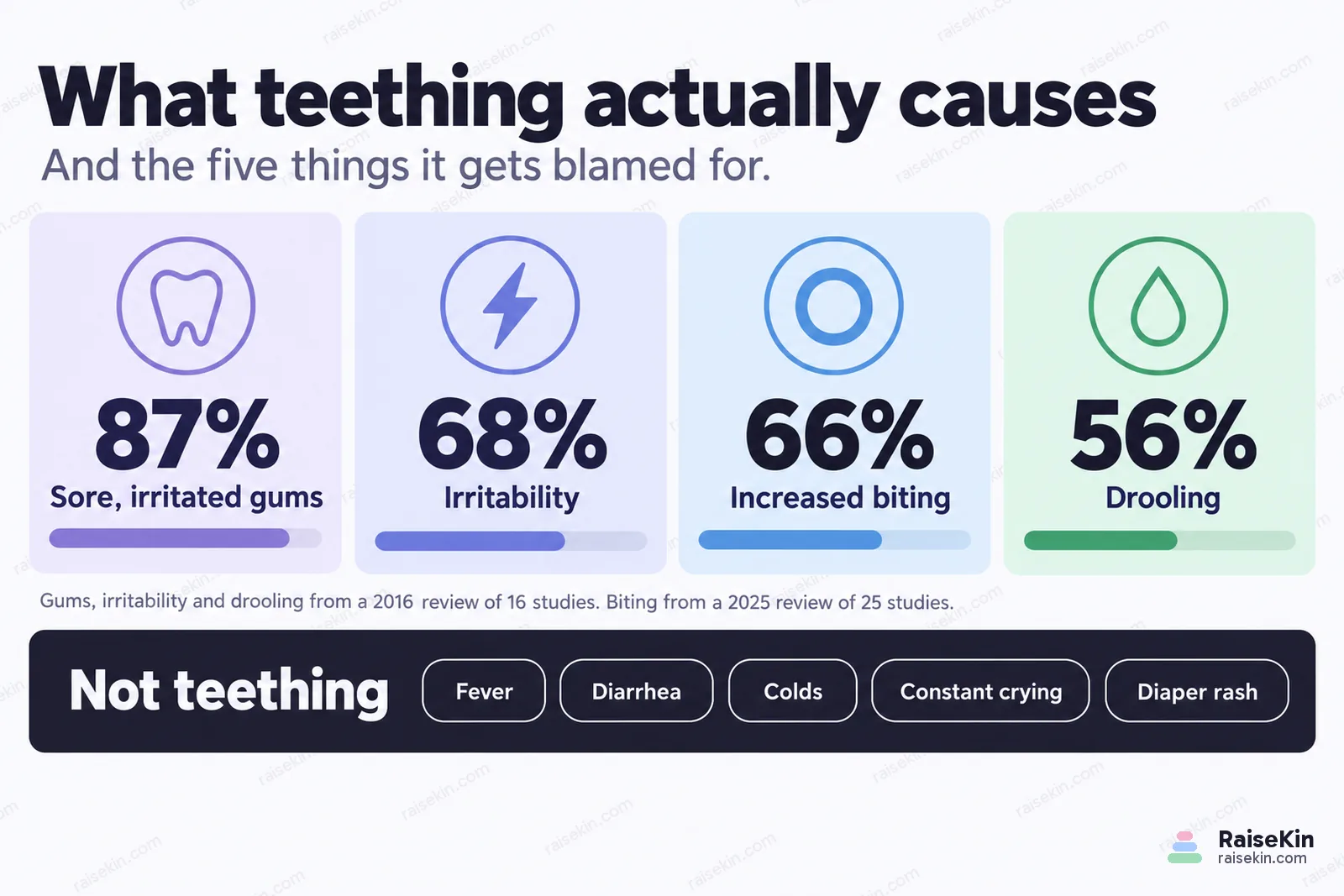
A 2016 meta-analysis pooled 16 studies covering 3,506 children up to three years old. Gingival irritation came out at 86.81%, irritability at 68.19%, and drooling at 55.72%. A larger review in 2025 pooled 25 studies, put the overall prevalence of teething problems at 80%, and found increased biting the most common local sign at 65.9% and irritability the most common general one at 60.7%.
So sore gums are nearly universal, and the rest are common but not guaranteed. A baby can be teething with no drooling at all. If your baby has none of the top four, teething is a weak explanation for whatever is going on.
Both reviews pool observational studies rather than trials, and the 2016 authors noted the studies defined symptoms differently. Read these as a reliable ranking, not as precise rates.
The five things that get blamed on teething and are not
This list matters more than the first one, because each item is something that gets waited out when it should be looked at.
A fever. A tooth can lift a temperature slightly. It cannot produce a fever, and 38C or 100.4F is the line. The full guide is here, including why two health bodies put that line in different places.
Diarrhea. Teething does not change the way a baby's gut works, so it cannot loosen stools. The reasoning and the one-day rule.
A cold, a runny nose, congestion, a cough. This one has the most satisfying explanation of the lot. Teething does not affect a child's immune system. But babies and toddlers put almost everything in their mouths, so they take in more germs, which leads to more colds and infections. The teething and the cold are both real, and the chewing is the link between them, not the tooth.
Crying that will not settle. Teething discomfort is generally not severe enough to make a baby cry more than usual. Prolonged inconsolable crying is a reason to call, not a stage to get through.
Diaper rash. Teething does not make skin more sensitive below the waist, so a sore bottom is a reaction to something else.
Can a baby have symptoms with no tooth?
Yes, and it is one of the most common things parents ask.
Dribbling steps up at around 2 to 3 months, often well before any tooth, because the glands become more active and a baby cannot yet swallow the extra. So a very dribbly 3-month-old is usually a 3-month-old, not a baby about to cut a tooth. Our baby teeth chart shows which teeth are actually due at your baby's age, and the onset guide covers the window the first one arrives in.
Gum symptoms can also run ahead of a visible tooth, which is why a sore gum with nothing showing is still worth taking at face value.
How long do symptoms last?
Per tooth, a matter of days around the eruption rather than weeks. Across childhood, on and off until the back molars finish, well into the third year.
That spread is why teething gets blamed for so much. A baby is teething for a large share of their first few years, so almost anything else that happens to them happens during teething too. Overlap is not cause, and it is the single most useful idea on this page.
If symptoms have run for a week or more without easing, that is not how teething behaves, and it is worth asking someone.
Why it seems worse at night
Nothing in the guidance says teething intensifies after dark. What changes is everything else: no distraction, a tired baby, a tired parent, and a quiet room where discomfort has nothing to compete with.
That is worth knowing mostly so it does not read as a worsening symptom. A baby who is settled by day and miserable only at night is behaving normally for teething. A baby who is miserable at both is telling you something else.
What actually helps
Unglamorous and short, because the real list is short.
Pressure on the gum is what works: a clean finger, a cool spoon, a damp gauze pad or flannel, and a teether made of solid rubber. Avoid plastic objects and liquid-filled teethers.
Never use teething gels to numb the gums. The AAP warns that in rare cases they can poison a baby's blood cells and stop them carrying oxygen.
When to call your pediatrician
Get in touch with your pediatrician or doctor if your baby has:
- A temperature of 38C or 100.4F or above
- Diarrhea, or vomiting
- A rash that is spreading, or anywhere dribble cannot reach
- Crying that will not settle, or a baby who is hard to rouse
- Symptoms that have run for a week or more without easing
- Anything that worries you, whatever the gums are doing
This guide is general information, not medical advice. For your child's health or development, speak to your pediatrician or doctor.
Frequently asked questions
What are the first signs of teething?
Sore, irritated gums first, which the research puts at around 87% of teething babies. Then more dribbling than usual, chewing on everything within reach, and a shorter fuse. Most babies show some of these before a tooth is visible.
What are the signs of teething in infants?
The same four: a sore red gum, dribbling, gnawing and chewing, and more fretfulness than usual, often with broken sleep and less interest in food. Published lists add one flushed cheek and a rash on the face, which is a dribble rash caused by saliva.
Can teething cause a runny nose or a cold?
No. Teething does not affect the immune system. What it does do is put a baby's hands and everything else in their mouth, which takes in more germs, so colds genuinely are more common in this stretch. The cold is real, the link is the chewing, not the tooth.
How long do teething symptoms last?
Days around each tooth, rather than weeks. Symptoms that run for a week or more without easing are not behaving like teething and are worth a call.
Can my baby have teething symptoms with no teeth?
Yes. Dribbling increases at around 2 to 3 months, before most first teeth, and gum discomfort can come before anything is visible. A very dribbly young baby is usually just a dribbly young baby.
What counts as severe teething symptoms?
Nothing, in the sense people mean. Teething discomfort is generally mild and short, so anything you would call severe, inconsolable crying, a fever, a baby who cannot be settled, is a reason to get advice rather than a worse grade of teething.
Are teething symptoms worse at night?
They are more noticeable at night, which is not the same thing. No guidance describes teething intensifying after dark. A quiet room with no distraction and a tired baby accounts for most of it.
Sources
- Teething Pain Relief, American Academy of Pediatrics. The symptom list, the false signs of teething and the reason given for each, including the immune-system point and the germs explanation, plus the warning on teething gels.
- Baby teething symptoms, NHS. The symptom list, one flushed cheek, the rash on the face, and the sub-38C threshold.
- Teething (Teething Syndrome), Cleveland Clinic. Fussiness, irritability, difficulty sleeping, loss of appetite and biting, the 38C and 100.4F line, and the solid-rubber teether guidance.
- Massignan C, Cardoso M, Porporatti AL, et al. Signs and Symptoms of Primary Tooth Eruption: A Meta-analysis. Pediatrics. 2016;137(3):e20153501. Sixteen studies, 3,506 children, gingival irritation 86.81%, irritability 68.19%, drooling 55.72%. doi:10.1542/peds.2015-3501.
- Garima J, Mathur VP, Tewari N, et al. Global prevalence of teething problems in infants and children, a systematic review and meta-analysis. International Journal of Paediatric Dentistry. 2025 May. Twenty-five studies, 80% overall prevalence, increased biting 65.9%, irritability 60.7%. doi:10.1111/ipd.13272.
- Drooling Baby? Here's Why Spit Happens, American Academy of Pediatrics. Saliva glands becoming more active at around 2 to 3 months, and where a drool rash appears.
Both reviews pool observational studies rather than trials, and the 2016 authors noted that symptom definitions varied between the studies included. Read the percentages as a ranking of how commonly each sign is reported, not as precise rates.
More from our teething cluster
- Teething Rash. Where a dribble rash appears, and why a rash on the body is not teething.
- Can Teething Cause a Fever?. Where the line sits, and why the health bodies disagree about it.
- Teething Diarrhea. Why loose stools are not a teething symptom.
- When Do Infants Start Teething?. The 4 to 7 month window, and the order teeth arrive in.